The »Ben-Haim-Forschungszentrum« – an initiative of the University of Music and Theatre Munich – investigates the history and music of persecuted composers, as well as Jewish musical culture in all its diversity, before, during and after the Nazi era, with a focus on southern Germany. Not least because of its main building at Arcisstraße 12, a former Nazi landmark, the University feels a particular historical responsibility in this regard. The biographies of numerous former members and students of the Academy of Music are inextricably linked to the Nazi past.
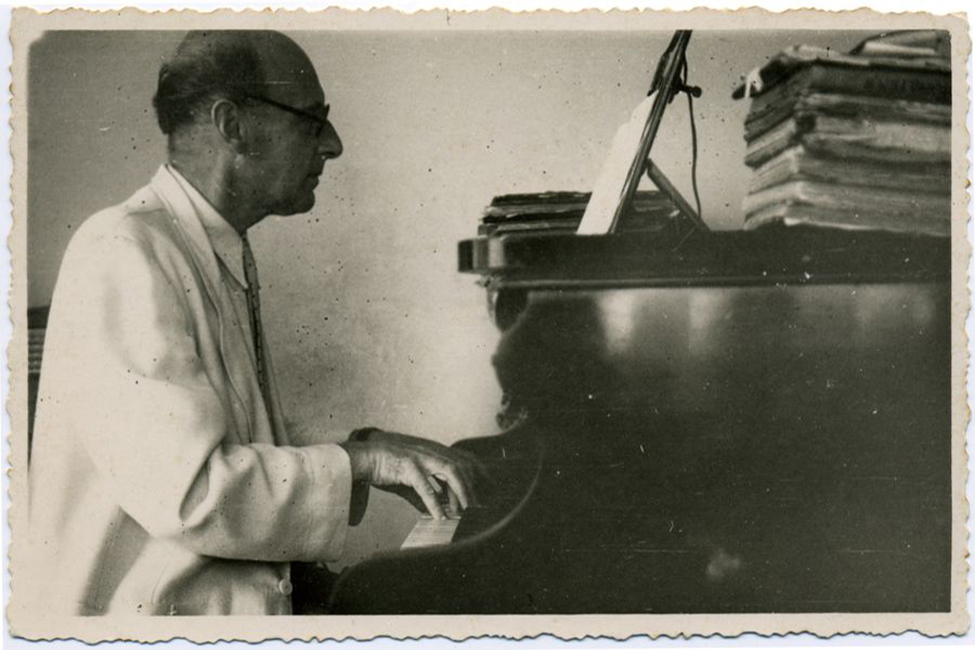
This was also the case with Paul Ben-Haim, after whom the research centre is named: the conductor, composer and former student of the conservatoire, who was born in Munich in 1897 as Paul Frankenburger, emigrated to Palestine in 1933 due to severe anti-Semitic persecution, where he changed his surname to Ben-Haim (»son of Heinrich«). Ben-Haim’s life story is representative of that of many other Jewish musicians who were driven out by National Socialism. During his exile, he became one of the most influential figures in the musical life of Palestine and in the development of an Israeli national style.
The Centre’s research work, which is complemented by teaching, lectures, publications and concert events, aims to contribute to the study of the history of Jewish artists, to promote a vibrant culture of remembrance for Jewish music and Jewish musicians in Munich and throughout Bavaria, and to make this accessible to a wide audience. The Centre holds a wealth of source material, particularly on Paul Ben-Haim and Wolfgang Jacobi (1894–1972), two musical figures whose history is closely linked to our University.
The Academy of Fine Arts, Munich (AdBK) and the HMTM are conducting joint research into artists persecuted by the Nazis at their respective institutions. This is the first systematic and academic examination of the biographies of artists who were excluded, marginalised and persecuted – and in some cases subsequently murdered – at the »Münchener Akademien für Bildende Kunst und für Tonkunst«. The research project also examines institutional practices during the period from the rise of National Socialism through to the early post-war years. The collaboration between the AdBK and the HMTM makes it possible to establish connections between music and the visual arts, and to identify artistic responses to the mechanisms of persecution under National Socialism. Questions arising from artistic research make a significant contribution to academic discourse at both universities. Combined with methods of historical research, this opens up new approaches to a critical history of institutions.
Project lead:
Prof. Dr. Maria Muhle (AdBK), Dr. Tobias Reichard (HMTM)
Project staff:
Beo Tomek (AdBK), Leon Zmelty (HMTM)
Duration:
2023–2027
Funding:
»Hochschulvertrag«
»Island«, »oasis«, »refuge«, »stronghold of resistance«, »prison«, »intellectual ghetto«… Virtually all contemporary accounts of Jewish musical and theatrical life under National Socialism are permeated by such spatial metaphors. Semantics of confinement and constriction, but also of the blurring of boundaries and withdrawal – extending even to the subversive and the resistant – are, in their spatial context, representative of Jewish everyday experiences under the Nazi dictatorship. They were the result of an increasingly strict regulation of public space, through which Jews were to be completely marginalised from society in accordance with the will of those in power. In musical life in particular, the pressure of persecution was exceptionally high from the outset, as music—regarded as the ›most German of the arts‹—was a core component of National Socialist ideology. Jewish musicians were therefore forced to create alternative means of earning a living and opportunities to perform within a very short space of time. Just like their Jewish audiences, they had to find their bearings in a public sphere that was deeply marked by violence and which proved particularly precarious in Bavaria – with Munich, the »capital of the movement«; Nuremberg, the ‘city of the Reich Party Congresses’; Bayreuth, the city of Wagner; and Dachau, the first concentration camp. Jewish musical life under National Socialism was thus significantly shaped at various levels by spatial conditions, which, however, have scarcely been researched to date. The aims of the proposed project are to examine these conditions using Bavaria as a case study, to systematically catalogue and analyse the relevant sources, and to explore how these findings might inform a music historiography that is sensitive to spatial contexts.
Project lead:
Dr. Tobias Reichard
Project staff:
Dr. Lorenz Adamer, Stefanie Mockert
Assistants:
Lorenz Kaineder, Konstantin Mulki, Maximilian Stoll
Duration:
2025–2028
Funding:
»Deutsche Forschungsgemeinschaft« (DFG)
Wolfgang Jacobi, born on Rügen in 1894, enjoyed his first major successes with his compositions in the 1920s. His flourishing career came to an end when the National Socialists came to power, as he was barred from practising his profession due to his Jewish heritage. After a brief period in exile in Italy, he spent the years leading up to the end of the Nazi dictatorship living in seclusion in Munich. As a composer with no political taint and an established artistic reputation, he was all the more in demand after 1945. As a lecturer in composition, he played a pivotal role in shaping the post-war history of the Academy of Music.
Under the leadership of Dr Barbara Kienscherf, Jacobi’s extensive estate – which includes, amongst other things, musical manuscripts, around 6,000 letters, press articles and photographs – has been systematically catalogued and digitised since October 2022. The estate is already available to those with an academic or artistic interest, subject to prior contact.
Project lead:
Dr. Barbara Kienscherf, Dr. Tobias Reichard
Project staff:
Christoph Schuller
Duration:
seit 2022