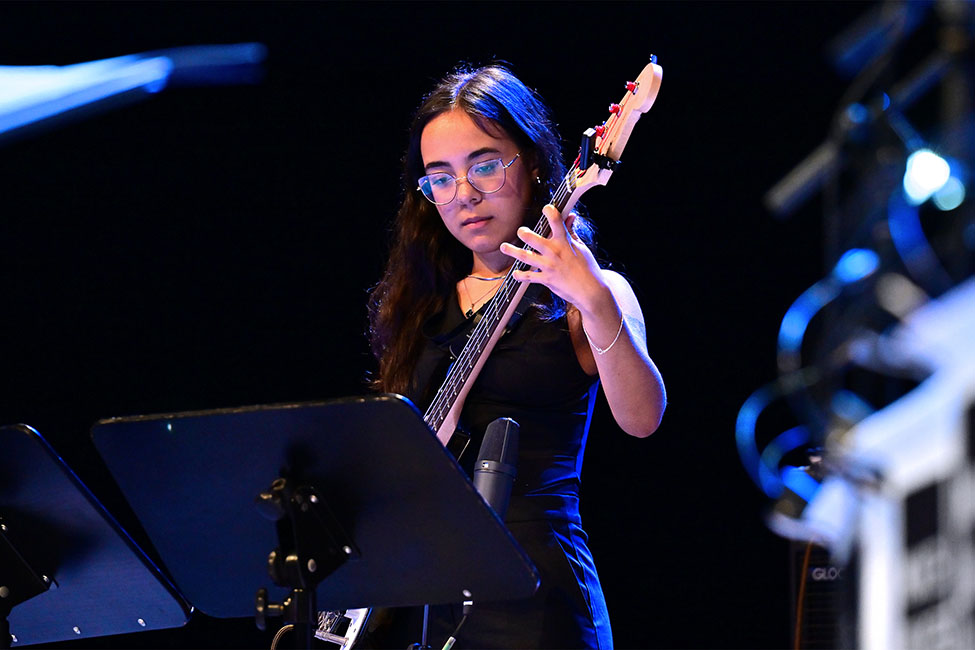
Laryssa Alves on the experience and her stay in Munich:
»In June of 2025, I experienced one of the most significant moments of my life: my first flight, my first time leaving São Paulo, and a month-long stay in Munich, Germany, for a period of musical studies.
I arrived without any knowledge of the local language and was immediately faced with navigating the German public transportation system — first the S-Bahn, then the U-Bahn, which passed through the beautiful English Garden. The city, in the midst of spring, welcomed me with radiant charm: blooming flowers everywhere, sunsets around 10 p.m., and an atmosphere of calm, respect for nature, and aesthetic harmony that captivated me from the start.
On the first day, we had lunch at a Vietnamese restaurant with Martin Zenker, Robin, and Aidana – two students who played a crucial role in supporting us during those initial days. We were housed in a student dormitory, and from that point forward, the month unfolded in a unique rhythm – one marked by discovery, music, and multicultural interaction.
It was a period of intense musical development, cultural immersion, and transformative experiences. Our schedule, initially open, gradually filled with rehearsals, performances, birthday celebrations, recitals by friends, swims in the Isar River, walks through the city center, meals at colleagues’ homes, and an unforgettable concert by Aaron Parks.
The infrastructure at the Hochschule für Musik und Theater München was remarkable. I had the opportunity to explore both the Gasteig HP8 and Arcisstraße 12, which houses a richly equipped library – still widely used, with quiet study areas and impeccably maintained studios. The Gasteig HP8 also impressed with its modern facilities, excellent coustic insulation, and high-quality instruments. I vividly remember the excitement of playing a beautifully built double bass – the kind I relied on for daily practice. Both Marlon Cordeiro and I were struck by the freedom to study at any hour. This stood in stark contrast to what we are used to in São Paulo, where institutional access to practice rooms is typically limited and often unavailable on weekends. For students without personal instruments or the means to practice at home, having access to open, well-equipped facilities 24/7 can be profoundly motivating and transformative – and in my case, it certainly was. This environment significantly enhanced our musical productivity and our overall experience in Munich.
Equally enriching was the international atmosphere. We engaged with students from countries such as South Africa, Mongolia, Kazakhstan, France, Romania, Ukraine, and Tanzania – all united by a shared passion for music and personal growth. These interactions fostered a rich cultural and artistic exchange, where each individual contributed their unique background and perspective. Language barriers quickly dissolved into a shared musical understanding.
Classes with Martin Zenker were both efficient and impactful. His direct and pragmatic approach differed from many pedagogical styles I had previously encountered and offered a fresh perspective on technical and musical problem-solving. I also studied electric bass with Patrick Scales, who supported my development in harmony, walking bass, and technique. Both provided invaluable insights regarding fingering, intonation, harmonic understanding, and study habits – lessons I continue to apply in my musical journey. From a musical standpoint, I returned a different person from the one who arrived – deeply transformed by the intensity of the experience. I am especially grateful to Martin and Patrick, as well as to Henning Sieverts and Professors Christian Lettner. I would also like to express my special thanks to Christian, whose fluent Portuguese and natural feel for Brazilian music made both Marlon and me feel more at home.
Munich’s musical and cultural life is vibrant and inspiring. The jazz club Unterfahrt stands out as a meeting point for students and professionals, offering energetic jam sessions and highlevel performances. We attended concerts by local and international artists and witnessed a city that lives music in a deeply integrated and organic way. The residency of Danilo Pérez was another highlight — his lectures and Big Band performances radiated artistic generosity and commitment. Experiencing such a dynamic and diverse musical ecosystem reaffirmed my desire to continue studying and growing with the same dedication and enthusiasm I found there.
I also had the opportunity to explore nearby cities such as Nuremberg, Schliersee, and Starnberg, where I met Camilo Dornier — a key figure in the realization of this exchange. It was an honor to spend two afternoons in conversation with him and Marlon Cordeiro. I am deeply grateful to Camilo, whose connection to music was instrumental in making this project possible, and to Thomas Janzen for his kind and thoughtful logistical support.
Another personal milestone was traveling alone to Mainz. While Marlon remained in Munich, I navigated the central train station – München Hauptbahnhof – independently, purchased my own tickets, and completed the trip on my own. This experience gave me a new sense of autonomy and confidence. A few days later, I accompanied Marlon on a visit to the Dachau concentration camp – the first of its kind – an emotionally difficult yet essential experience. Confronting the history of the Holocaust in such a direct and tangible way was deeply moving and necessary.
Throughout the month, I had the privilege of meeting remarkable individuals who made each day more meaningful — Jakob Marsmann, Tibor Lampe, Loni, Linus, Ida Valentina, Aidana, and Robin, who filled our days with warmth and companionship. Professor Martin Zenker was not only my double bass instructor, but also a constant mentor, cultural guide, and essential presence throughout the program.
As a woman navigating the jazz world, I am familiar with the gender-related challenges that permeate the musical environment – a field still largely dominated by men. For this reason, being a 21-year-old female double bassist, the daughter of two parents who did not have the opportunity to pursue higher education, someone who had never left São Paulo before, and who studied at a free conservatory – a Latin American reference in popular music education – makes this experience all the more meaningful. Having the opportunity to travel to Europe, encounter a culture so different from my own, and continue to study jazz while honing my skills and connecting with people from such diverse backgrounds is truly priceless.
I am sincerely grateful to EMESP Tom Jobim, Santa Marcelina Cultura, Ana Beatriz Valente, Iago — who guided me through every step of the process — and my teacher Marinho Andreotti, who has mentored, inspired, and taught me for the past five years. Much of my progress is thanks to him. I owe everything I have achieved to EMESP — long may it thrive.
Munich taught me not only about music, but also about freedom, community, courage, and sensitivity. It was a month that expanded my horizons and that will forever hold a special place in my memory.«