Marlon Cordeiro on the experience and his stay in Munich:
»Taking part in this experience was a joy and a personal milestone. I had never been to Europe, let alone imagined doing so in a context of study, musical exchange, and living alongside new people. Munich in the summer impressed me: a planned, organized city, with plenty of nature, full parks, and people running and cycling. The weather helped, and the receptiveness I found in the streets and at the college was constant.
The college’s facilities are excellent: rooms with pianos in great condition, everything very organized, rest areas (also with a piano), and simple amenities that make a difference in daily life, such as a vending machine with water and snacks. Being able to arrive early, stay later, and study even on weekends made the routine productive in a way that, for me, is rare in Brazil. The students welcomed us well; we went on outings, studied together, and played at Aidana’s recital (Laryssa Alves and I). The international environment was enriching: besides the German colleagues, I interacted with people from South Africa, Mongolia, Kazakhstan, Ukraine, and Tanzania – all focused on musical growth. I came back inspired.
In my area, the saxophone, the students’ level is high, even among the youngest. The classes with Professor Florian Trübsbach were a strong point: generous, patient, and musical. We played together on sax; then he accompanied me on piano, carefully observed my strengths and areas for improvement, and proposed specific exercises. He shared his own materials and led everything in an encouraging and objective way.
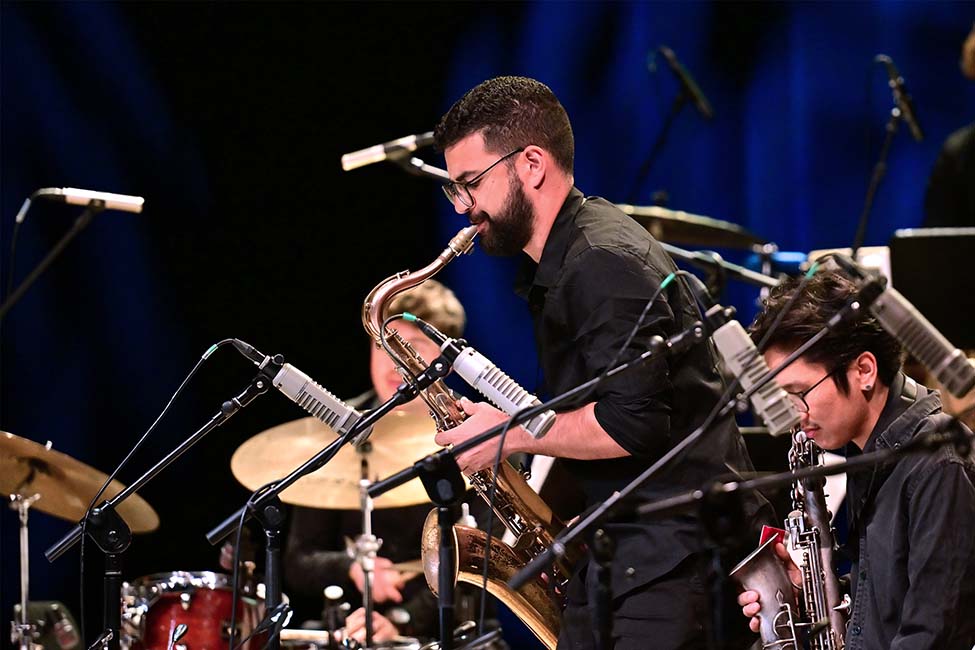
The city’s musical life is also impressive. At the Unterfahrt jazz club, in addition to consistent local artists, I attended jam sessions that show the integration between students and professionals. I also followed student performances in different formats – combos, big band, and recitals – always well prepared. Among them, a concert by vocalists with arrangements for a string ensemble stood out to me for the quality of the writing and the performance, but it was just one of the good experiences at the club. Taken together, it is a living portrait of the city’s musical ecosystem. Danilo Pérez’s »residency« was another highlight: didactic lectures on tetrachords and rhythms and the opportunity to play his repertoire with arrangements by Bill Dobbins and by Danilo himself. Playing with the college Big Band and stepping onto the Isarphilarmonie stage was a remarkable experience.
I would like to express my thanks. To Martin Zenker, our first contact still in Brazil, who handled the paperwork, requested documents, picked us up at the airport, took us to our accommodations, and taught classes – a fundamental presence for everything to run smoothly. To Professor Christian Leitner, who speaks Portuguese perfectly and plays Brazilian music with precision and naturalness, in addition to being a friend of our professor in Brazil, Rodrigo Ursaia. He invited us to a concert at Jazz Vogler and was always helpful. To Camilo Dornier, whose active bond with music was decisive: he personally came to Brazil, led the selection of the partner institutions – Faculdade Souza Lima and EMESP Tom Jobim – and made the trip possible with complete support (I was even able to acquire musical equipment with the remaining funds, something valuable given the cost in Brazil). His hospitality included a dinner where we talked about music (with photos from Ivan Lins’s visit) and a farewell jam session at his home, with Danilo Pérez, director Claus Reichstaller, Professor Mário Cunha and his family, among others. To Thomas Janzen, for his attention to detail, his passion for Brazilian literature (we talked about Machado de Assis and Jorge Amado), and his logistical support – including the ride after the first dinner, when we experienced stretches of fast highways, a pleasant curiosity for those who drive in Brazil.
To explain how I benefited, a brief personal overview helps. I am a young adult from the East Zone of São Paulo, from a peripheral region that, in the early 2000s, was strongly marked by violence. The public school I attended faced many difficulties, and my family’s financial situation was always tight. From this context, traveling abroad and living with other languages, cultures, and routines broadened my horizons in a concrete way.
On a personal level, I take away behavioral learnings – such as the value placed on silence and clarity. Academically, I discovered paths I didn’t know: in Brazil, as far as I know, there is still no specific master’s degree in popular saxophone; in Europe, I was able to understand how these programs work by talking to students and learning about real training possibilities. This motivated me to plan the continuation of my studies and prepare better for selection processes. Musically, I returned with the conviction to reinforce fundamentals – technique, sound, reading, time, and repertoire – as a basis for the professional environment. In short, the trip presented me with a possible world and gave me practical direction to pursue higher goals.
Constructively, I leave some suggestions to enhance the experience. On the Brazilian side, it is useful to define and communicate in advance the selection model (exam or recommendation). In the first edition there was an exam at Faculdade Souza Lima; in the second, recommendation. Standardizing and publicizing the format in advance – at Souza Lima and, as far as I know, also at EMESP – allows students to prepare better: if by recommendation, that they pursue the corresponding criteria; if by exam, that they study with focus. After the result, ongoing guidance would help prepare those selected to arrive in Germany with a consistent Brazilian repertoire (a small »canon«) and ready to clearly explain our languages and styles. It would also be useful to receive, still in Brazil, operational information about the concerts: the planned ensemble (so we can get a head start on arrangements and repertoire), how many concert outfits to bring, and the expected dress code (semi-formal, full formal, etc.). In cases like Unterfahrt, knowing the concert format in advance helps select repertoire ahead of time. Finally, a brief cultural and language briefing helps a lot: encouraging early practice of English (classes, rehearsals, integration) and basic German (daily tasks) and sending a summary of local customs – for example, how tipping and other etiquette work – prevents misunderstandings and makes living together more natural.
I remain grateful for the opportunity and for all that I learned. I return to Brazil with new references, friends, and clear study goals — and with the sense that this partnership has plenty of room to grow. If these observations help refine the next steps, I am glad to contribute.«